Search the Past

In today’s world of content generated by the Weighted Random Word Generators (also known as Large Language Models (LLMs); too often incorrectly referred to as Artificial Intelligence), the vast majority of top search results are a mix of mainstream news sites and automatically generated articles, which are difficult to read and verify for correctness. Too many people simply read and trust the generated answer at the top of the search results. For those who want to look deeper, the first step is to set your Internet time machines to the past, before the era of the modern chatbot.
Time Machine
Here is a simple search form that supports date ranges for several search engines. I’ve made the source code available under the search the past project. You can easily modify it or embed it into your website or personal dashboard.
Technical challenges
Adding query parameters to Bing was a challenge. Their web user interface is broken, and you cannot manually type in dates on all web browsers I’ve tried. You have to click to cycle dates.
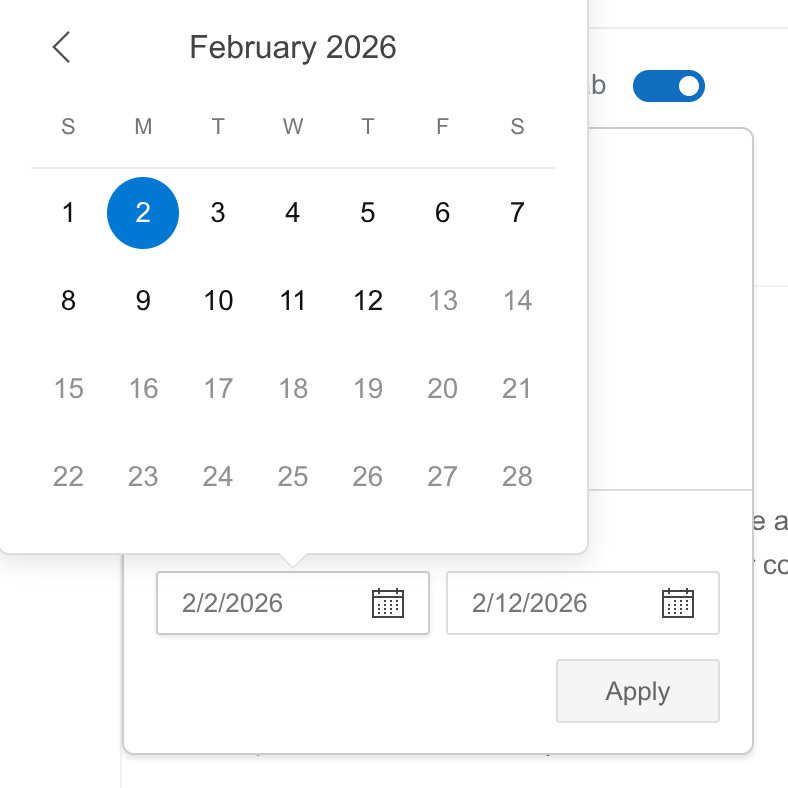
The query parameters Bing adds are complex, and even repeated interrogations to LLMs only produced queries that were wrong. Thankfully, someone on the Fediverse1 dug up a five-year old-post explaining Bing’s weird date system, which encodes dates as a filter in days since a specific epoch2.

Yandex’s user interface limits searches to time periods from the previous day, the last two weeks or last month. Their official documentation claim dates can be added directly to the query3, but I couldn’t get such searches to work. I suspect their documentation is no longer up to date. I’ve found Yandex to be an incredible resource for many things that are either not indexed or intentionally removed from Google, Bing and DuckDuckGo. However, I’ve removed it from this project for now, until I can figure out how to get date-specific queries working.
Fake Time Travelers
I found the following search result for the RTX 3080-Ti video card from 2006.
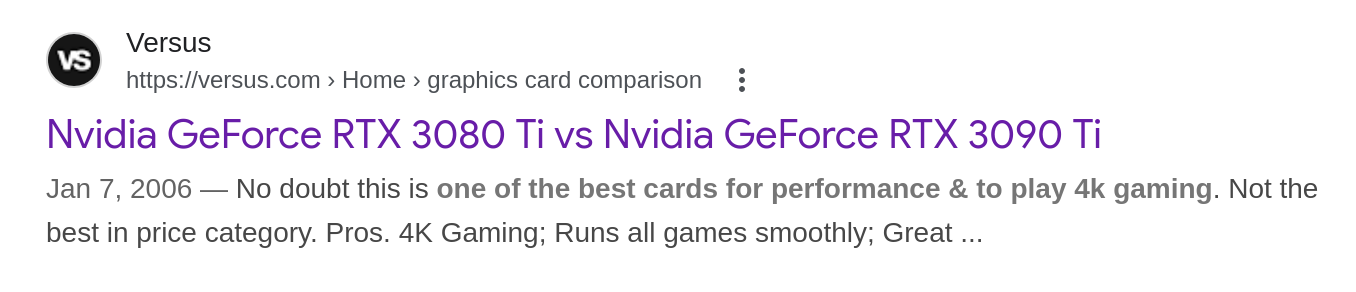
The trouble is, this video card didn’t exist in 2006. I purchased a 3080-Ti in 2021, a year after its release. This is a modern post that has its metadata set to be far in the past. This could just be an honest mistake, some type of weird search engine optimization (SEO) or an LLM-generated article.
It doesn’t really matter why this particular article exists, but it is important to realize the dates on web pages may not indicate their actual publication date. Another limitation of using major search engines is that we can only search for old websites that are still up. Websites that have left our world are only available via archival sites, which may have their own integrity problems.
Even with these limitations and caveats, using time-based queries for past search results can be incredibly useful for research and avoiding documents generated by modern LLMs.
Other Search Engines
There are several engines that specialize in indexing smaller websites. They can be useful in finding blogs, fringe websites and other interesting content.
- Wiby - “Search engine for the classic web.”
- Shodan - Search Engine for Internet-connected devices.
- Grep.app - Fast GitHub code search.
- ooh.directory - “A place to find good blogs that interest you.”
- Filmot - YouTube subtitle and caption search.
Closing Thoughts
The vast majority of people don’t go past the first page of search engine results4, not that it matters since most search engines never allow people to view more than a few pages anyway56. Google has been formed into a verb, with far too many people leaning on a sole search engine. In a 2005 interview with Eric Schmidt, who was the CEO of Google at the time, he stated that Google returning a list of results was a bug and that he desired for it to return one perfect result7. Two decades later, it seems as if the LLM era has gotten search engines closer to Schmidt’s original goal dystopian-level of thought control.
Most search engine and social media algorithms seem to favor posts that are current or recent. Their user interfaces often make it difficult to search for more niche content. Just as LLMs can be “hacked” using prompt injection to give unintended results, using date ranges on the major search engines is one technique that can be used to find obscure content from real human beings in the time before the modern LLM era.
-
He’s memeing, anyway here’s the only thing I could find on their retarded search query system. 13 Feburary 2026. @caronnov@dill.burggit.moe mirror ↩
-
So…how do you sort search results by time range?. 21 August 2025. cutcss. /r/bing. Reddit. ↩
-
Search by date, language, and file types. Retrieved 10 March 2026. Yandex. Archive ↩
-
Using the Internet: Skill related problems in users’ online behavior. Deursen. Dijk. June 2009. Interacting with Computers. Science Direct ↩
-
Where Did the Rest of the Internet Go?. 11 April 2022. TruthStream Media. ↩
-
YES, They Really Are Deleting the Internet And it’s WAY Worse Than You Think. 15 August 2022. Bright Insight. ↩
-
Eric Schmidt - Charlie Rose. 3 June 2005. Charlie Rose. (Interview) Specific Clip ↩