When was the last time RAM was this expensive?
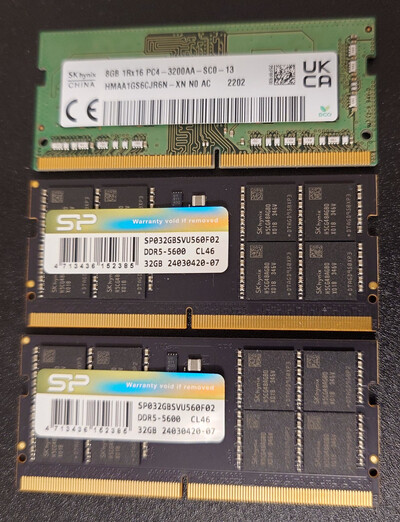
Memory has become insanely expensive over just the past few months. Micron cut production of Crucial, their consumer brand of memory, to focus on data center products at the end of 20251. This was after Micron received massive amounts of taxpayer money from the CHIPS Act2. Crucial’s exit has radically changed the market. We’ve seen big shifts in RAM prices over the past few decades. It has always been volatile, but it’s never been this bad. In this unprecedented time of memory pricing, I started going back through all my previous purchases to see how far into the past I’d have to go to see the current-day cost per byte of memory.
I built a desktop in 2016 after living out of two bags for nearly a year. It was the first desktop I had put together in years, and I spent $190 for 32GB of DDR4-3200 memory. A year later, I ended up selling that desktop before driving across the country. When I settled down in Chicago and decided to build another desktop, I paid $330 for 32GB of the same DDR4-3200 memory, a nearly 60% increase.
RAM prices spiked massively in 201834. Supply may have been constrained due to the Samsung Galaxy Note 7 recall5. There are only three major manufacturers of DRAM chips: Samsung, Micron and SK Hynix. Small supply and demand changes can have volatile effects, as we’re seeing today.
Recent Jumps
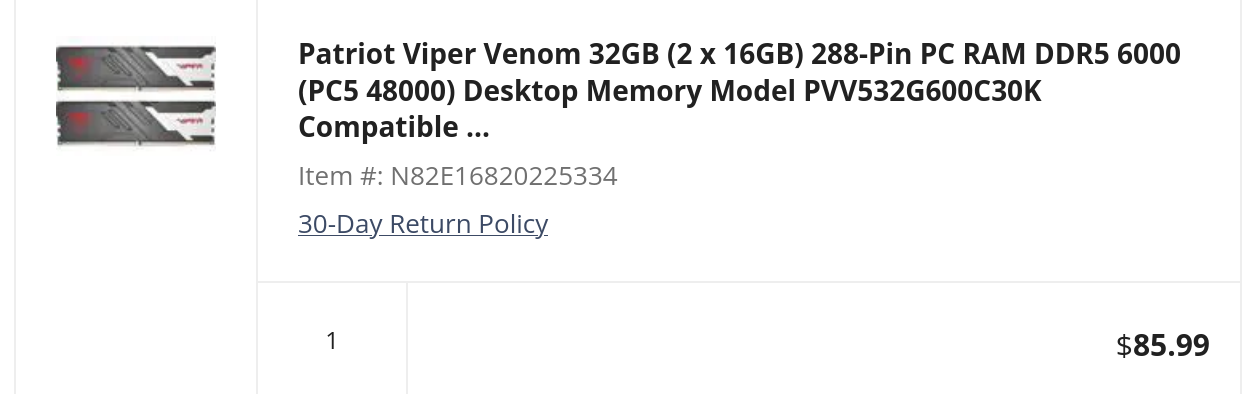
In September of 2025, I purchased this 32GB (2x16GB) RAM kit for $86. As of March 1st of this year, it was $370.

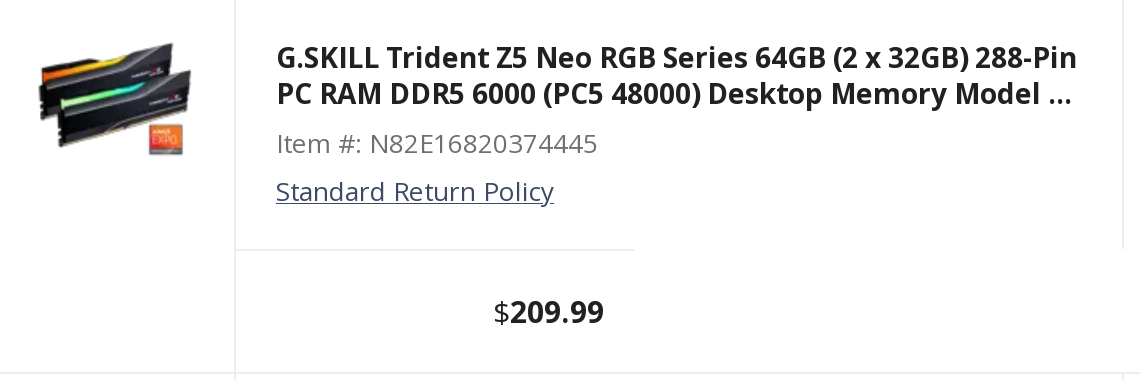
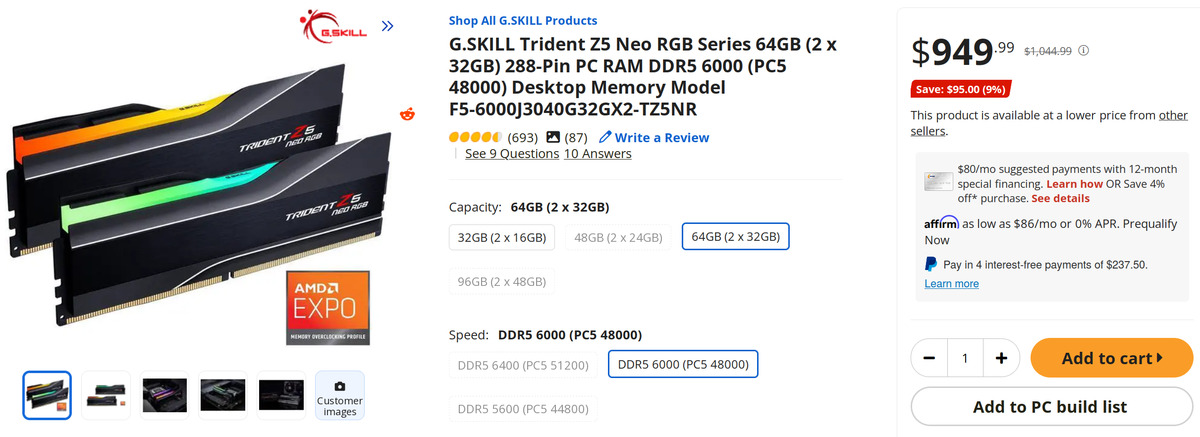
A 64GB DDR5-6000 set of RAM cost me $210 in July of 2024. In August 2023, it was around $3006. By the end of March 2026, it is currently $950.
| Date | Capacity | Type | Cost | Price Per GB |
|---|---|---|---|---|
| 2025, September | 32GB (2x16GB) | DDR5-6000 | $86 | $2.69 |
| 2026, March | - | - | $370 | $ 11.56 |
| 2025, February | 64GB (2x32GB) | DDR5-6000 | $90 | $1.41 |
| 2026, March | - | - | $950 | $14.84 |
The current data center and AI-mania has pushed most memory manufacturers to switch to production of enterprise high-bandwidth memory, leaving the consumer market in panicked short supply.
Price per Gigabyte
These are obviously massive increases in prices, but just how bad? Typically, consumer storage tends to gain capacity while reducing cost over time. How far back do we have to go before we see a regression to today’s prices? I decided to go back through decades of ancient e-mails, searching for old DDR orders from both large and small online retailers.
| Date | Capacity | Type | Cost | Price Per GB |
|---|---|---|---|---|
| 2005, May | 512MB | DDR PC3200 | $38 | $76 |
| 2006, January | 2GB (2x1GB) | DDR-266 PC2100 (Registered ECC) | $160 | $80 |
| 2006, February | 2GB (2x1GB) | DDR2-667 PC2-5400 | $156 | $78 |
| 2009, April | 1GB | DDR2-667 PC5400 (SODIMM) | $20 | $20 |
| 2009, May | 2GB | DDR2-667 PC5400 (SODIMM) | $29 | $14.50 |
| 2009, July | 4GB (2x2GB) | DDR2-1066 PC8500 | $140 | $35 |
| 2016, November | 8GB (2x4GB) | DDR4 (SODIMM) | $44 | $5.50 |
| 2016, December | 32GB (4x8GB) | DDR4-3200 | $190 | $5.94 |
| 2018, December | 32GB (2x16GB) | DDR4-3200 | $330 | $10.31 |
| 2020, September | 16GB (2x8GB) | DDR4-3200 | $57 | $3.56 |
| 2020, December | 64GB (2x32GB) | DDR4-3600 | $230 | $3.59 |
| 2021, November | 16GB (2x18GB) | DDR4-3000 | $50 | $3.13 |
| 2022, July | 64GB (2x32GB) | DDR4-3200 (SODIMM) | $160 | $2.50 |
| 2024, July | 64GB (2x32GB) | DDR5-6000 | $210 | $3.28 |
| 2024, November | 64GB (2x32GB) | DDR5-5600 (SODIMM) | $140 | $2.19 |
| 2025, February | 64GB (2x32GB) | DDR4-3200 | $90 | $1.41 |
| 2025, September | 32GB (2x16GB) | DDR5-6000 | $86 | $2.69 |
Of course, this isn’t a fair comparison, as I’m only looking at the price per GB. I’m also only looking at my purchases, not overall market data. Memory has changed over the years, both in DDR standards and in bus speed. Many of these purchases came in matched kits as well, to take advantage of dual-channel configurations. A 2x16GB pair might run at a lower cost per GB than a single 32GB due to chip density, but for the sake of simple comparison, we’re going to ignore that as well.
The Height of Memory Mania
Once again, let’s compare the capacity cost of the current market, ignoring everything else.
| Date | Capacity | Type | Cost | Price Per GB |
|---|---|---|---|---|
| 2026, March | 64GB (2x32GB) | DDR5-6000 | $950 | $14.84 |
| 2026, March | 32GB (2x16GB) | DDR5-6000 | $370 | $ 11.56 |
I would have to go back to 2009 to get to our current cost-per-gigabyte market price. The largest capacities I could find for consumer-grade memory during this time period were 6GB sticks of DDR3, which ran for around $180, or $30 per GB7. Getting anywhere near current memory capacity back then likely required server hardware and enterprise motherboards.
Pressure Release
We have regressed a decade and a half when it comes to RAM prices. 4K editing, software development, local AI models, gaming and the ever-increasing bloated requirements from web browsers and Electron applications have all pushed up memory requirements a lot for general computer use. Yet, due to massive data center expansion, RAM scarcity is forcing prices outside the range for most normal consumers.
There eventually must be a pressure release. It could be the impending and easily predictable collapse of the AI bubble, or it could be the United States government finally removing sanctions from ChangXin Memory Technologies (CXMT), allowing for another supplier to compete in the market.
The danger of continued high RAM prices is that it could push more services into data centers and away from local machines and homelabs. Even businesses may push developers to utilize more cloud architecture rather than provide their staff with sufficiently powerful laptops for their technology stacks. Decades of technological innovation that have pushed more compute and storage power to individual engineers could regress due to the price of chip-based storage.
When will we see reasonable prices for consumer RAM, as well as for NVMe storage that’s also risen dramatically? The DRAM industry is a difficult market to enter into, and has long been held by a small cartel of chip manufacturers8, some of whom have been charged and pleaded guilty to illegal price fixing9. Gartner is predicting we won’t see slowdowns in the AI markets until 202710, which could lead to entry level gaming PCs becoming affordable by 202811.
The availability of affordable consumer compute has radically changed what people have been able to create and do for the past several years. There’s been a large democratization of technology12, and constricting supply only benefits those who offer cloud services and software subscriptions. It’s a terrible hit for enthusiasts that may go unnoticed by those who are fine with renting and not owning hardware.
-
WTF Just Happened? - The Corrupt Memory Industry & Micron. 5 December 2025. Gamers Nexus. ↩
-
Trump’s big bill boosts Micron’s tax break for Clay chip plants by about $5 billion. 26 July 2025. Weiner. Syracuse. ↩
-
Why RAM Prices Are Through the Roof. 30 January 2018. Hruska. ExtremeTech. ↩
-
RAM Price Report: DDR4 Same Price as Initial Launch. 22 January 2018. Lathan. Burke. GamersNexus. ↩
-
Samsung Galaxy Note 7 recall: Here’s what happens now. 22 January 2017. Dolcourt. CNet. ↩
-
This 32GB kit I bought in September, for $86 … is now $370. 1 March 2026. @djsumdog@djsumdog.com. mirror ↩
-
Memory - DDR3 RAM. TigerDirect. Archive from 8 December 2009 ↩
-
The DRAM Cartel - Price Fixing, Anti-Consumer Collusion, & Corporate Conspiracy. 6 March 2026. GamersNexus. ↩
-
Japanese Company Agrees To Plead Guilty To Participating In Dram Price- Fixing Conspiracy. 30 January 2006. US Department of Justice. ↩
-
Gartner Says Surging Memory Costs Will Reduce Global PC and Smartphone Shipments in 2026l. 26 Feburary 2026. Gartner. ↩
-
Gaming PCs will be too expensive for ordinary people by 2028 predicts report. 5 March 2026. Beckwith. Metro. ↩
-
An Army of Davids. Reynolds. (2006) ↩